
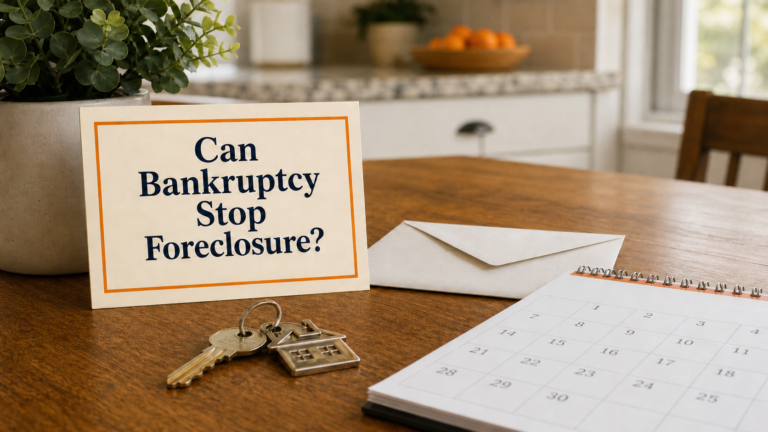
What the Automatic Stay Does
The automatic stay is a federal court order that normally begins when a bankruptcy case is filed. It stops most collection activity, including an unfinished foreclosure. The United States Courts explains the bankruptcy process and warns that bankruptcy information is not a substitute for legal or financial advice.
The stay can provide breathing room to review the mortgage, income, other debts, and available property choices. It does not erase the mortgage lien, transfer ownership, or guarantee that the homeowner can keep the house.
A lender may ask the bankruptcy court to lift the stay. The stay may also end if the case is dismissed, closed, or handled under special repeat-filing rules. A homeowner should not assume that a scheduled auction disappeared merely because a case was filed.
Confirm these facts immediately:
- the exact foreclosure sale date and time
- whether the bankruptcy petition was successfully filed
- the case number and chapter
- whether the lender received notice
- whether a motion to lift the stay has been filed
- whether current mortgage and plan payments are affordable
How Chapter 7 Affects an Active Foreclosure
Chapter 7 bankruptcy is a liquidation process. A trustee reviews the debtor's property, exemptions, debts, and financial records. Many cases have no nonexempt assets to sell, but the treatment of a house depends on equity, exemptions, liens, payment status, and the trustee's review.
Chapter 7 may pause foreclosure through the automatic stay and may discharge personal responsibility for some eligible debts. A discharge does not normally remove a valid mortgage lien. If payments are not brought current or another agreement is not reached, the lender may still be able to continue foreclosure after the stay ends or is lifted.
Chapter 7 may make sense when the main need is relief from other debt and the homeowner does not have a workable plan to keep the house. It can also create time to evaluate a voluntary sale, but the debtor must tell the bankruptcy attorney about any proposed sale. The house and sale proceeds may be part of the bankruptcy estate, and court or trustee approval may be needed.
How Chapter 13 Affects an Active Foreclosure
Chapter 13 bankruptcy is built around a court-approved repayment plan, usually lasting three to five years. The U.S. Courts explains that Chapter 13 may allow a homeowner to stop a foreclosure and cure past-due mortgage payments over time.
That opportunity has conditions. The homeowner generally needs enough regular income to make the plan payment and keep paying new mortgage payments as they come due. Falling behind again can put the house at risk.
Chapter 13 is not automatically better because it offers a repayment plan. A plan that works only on paper can delay a difficult decision while missed payments, legal costs, property expenses, and stress continue.
Chapter 7 Versus Chapter 13
Use the real goal to compare the chapters:
| Question | Chapter 7 | Chapter 13 |
|---|---|---|
| Main structure | Liquidation and discharge of eligible debt | Court-approved repayment plan |
| Typical length | Often shorter | Usually three to five years |
| Catch up mortgage arrears over a plan | Usually no | Often possible if the plan is feasible |
| Automatic stay | Usually begins at filing | Usually begins at filing |
| Keeps foreclosure stopped forever | No | No |
| House and equity reviewed | Yes | Yes |
The right answer depends on income, equity, exemptions, mortgage arrears, other debt, prior filings, and the homeowner's goal. Use a bankruptcy attorney who can review the full situation before the sale date.
Filing Before the Sale Date Matters
The U.S. Courts specifically notes that a homeowner may still lose the home if the lender completed the foreclosure sale under state law before the Chapter 13 petition was filed. Do not plan around a rough date or an old letter. Confirm the live sale information with the mortgage servicer, foreclosure attorney, and bankruptcy attorney.
The Arkansas Attorney General's foreclosure page also encourages homeowners to contact the lender or servicer about available loss-mitigation choices.
Bankruptcy and Selling the House
Bankruptcy does not always prevent a voluntary sale, but the sale must fit the bankruptcy case. The homeowner may need approval from the trustee or court. Sale proceeds cannot simply be distributed without checking liens, exemptions, costs, and bankruptcy requirements.
If selling is being considered, compare:
- the confirmed foreclosure deadline
- the mortgage payoff and other liens
- the likely net proceeds
- the time required for bankruptcy approval and closing
- the cost of keeping the property during the case
Our guide to options before an Arkansas foreclosure sale explains loan modification, repayment, reinstatement, and sale choices. A homeowner with little equity may also need to understand the difference between a short sale, deed in lieu, and foreclosure.
A Safe Next-Step Order
- Confirm the foreclosure sale date in writing.
- Gather the mortgage statement, notice, income records, tax returns, and a list of all debts.
- Speak with an Arkansas bankruptcy attorney before filing.
- Ask whether Chapter 7 or Chapter 13 supports the actual goal.
- Confirm what happens to the house, equity, and any proposed sale.
- Keep checking the bankruptcy docket and foreclosure status.
Paranova can provide an as-is cash offer for comparison when selling is one of the approved choices. We cannot advise which bankruptcy chapter to file, stop a foreclosure by ourselves, or replace the bankruptcy court, attorney, lender, or trustee.