
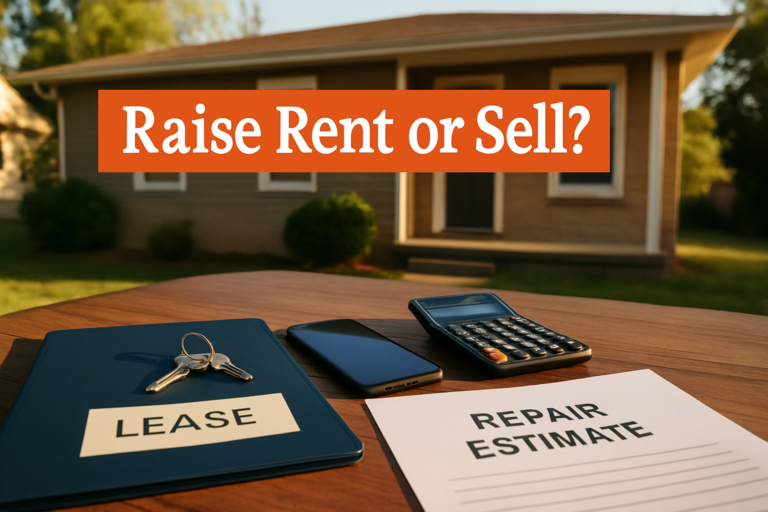
Start With The Rental Decision, Not The Rent Number
When a rental house starts feeling thin on cash flow, the obvious question is usually:
"Can I raise the rent?"
That question matters, but it is not always the first useful question. A rent increase only helps if the rental still works as an investment after repairs, vacancy, tenant risk, insurance, taxes, management time, and future sale options are considered together.
For some Arkansas landlords, the best move is to raise rent and keep a good tenant. For others, the rent gap is only a symptom. The real problem may be an aging roof, an HVAC system near the end of its life, repeated plumbing calls, tenant turnover, or the simple fact that the owner no longer wants to keep managing the house.
If the rental is becoming harder to operate, this decision belongs under rental and tenant problems in Little Rock and Central Arkansas, not just a rent-pricing question.
The Five Questions To Ask First
Before deciding whether to raise rent, repair, list, or sell directly as-is, walk through five questions.
1. What Does The Lease Allow Right Now?
Start with the lease, not the market.
The Arkansas Attorney General's landlord/tenant guidance says landlords must provide notice of at least one rental period before raising rent, and written leases can control notice, move-out, and repair expectations. That does not mean every rental situation is simple. Lease terms, tenant status, subsidized housing rules, local requirements, and legal questions can change what is appropriate.
This article is not legal advice. If lease timing, notice, eviction, tenant rights, or repair obligations are unclear, slow down and ask a qualified professional before acting.
2. Is The Rent Actually The Problem?
Sometimes a rental is simply under market. If the tenant is stable, the house is in decent condition, and the rent is meaningfully low, a reasonable rent adjustment may keep the property worth holding.
But rent benchmarks do not decide the whole answer. HUD's Fair Market Rent data, local listings, property manager input, and neighborhood comps can give context. They do not tell you whether your specific house is worth another repair cycle.
A $150 monthly rent increase sounds helpful. But if the house needs a $9,000 HVAC replacement, has old plumbing, and may sit vacant during turnover, the math is not just rent.
3. What Is The Repair Stack?
One repair is different from a repair stack.
A rental with one manageable issue may still be a good hold. A rental with roof age, HVAC issues, plumbing calls, flooring damage, old windows, foundation movement, or code concerns may be moving into a different category.
Ask:
- What repairs are needed now?
- What repairs are likely in the next 12 to 24 months?
- Will the tenant stay during repairs?
- Will a turnover expose more damage?
- Would the house be financeable and easy to insure if you sold it later?
If the property has larger deferred maintenance, compare the rental decision with the broader major repairs sale path.
4. What Happens If The Tenant Leaves?
Raising rent can improve income, but it can also trigger a vacancy if the tenant decides to move.
Vacancy creates its own cost stack:
- missed rent
- cleaning
- repairs between tenants
- utilities
- lawn care
- security
- advertising
- property manager time
- risk that the next tenant is worse
If the house is older or already behind on maintenance, turnover may reveal more than expected. The property may need flooring, paint, appliances, plumbing work, yard cleanup, or safety repairs before it is ready again.
5. Do You Still Want To Own This Rental?
This is the question many landlords skip.
If you still like the property, trust the tenant, have repair reserves, and want long-term rental income, keeping the house may be reasonable.
If you are tired of calls, repairs, late rent, vacancy risk, or managing the house from another city, the rent number may not fix the real problem. At that point, read Tired of Being a Landlord in Arkansas? and compare the exit options honestly.
When Raising Rent May Make Sense
Raising rent may make sense when the rental is basically healthy.
That usually means:
- the tenant relationship is stable
- the lease timing is clear
- the house is in decent condition
- repairs are manageable
- vacancy would not create a major problem
- the rent is materially below current local context
- you still want to own the property
In that situation, the rental may simply need better pricing. A property manager or local rental professional may help you compare the rent, lease timing, and communication plan.
The important point is to avoid using a rent increase as a bandage for a property that has become too expensive or too time-consuming to keep.
When Repairs Or Turnover Change The Math
Repairs can turn a simple rent question into an ownership question.
For example, suppose the rent could increase by $125 per month. That is $1,500 per year before vacancy, maintenance, management, taxes, insurance, and other expenses.
If the house needs a $7,500 roof repair, a $5,000 HVAC repair, or a large turnover cleanup, the rent increase may not solve the bigger issue. It may only make the property look better on paper while the owner keeps absorbing risk.
This does not mean you should always sell a repair-heavy rental. It means the comparison should be honest:
- repair and keep
- repair and re-rent
- repair and list
- list as-is
- sell directly as-is
Each path has a different net result, timeline, and stress level.
Compare The Main Paths
Here is a practical way to compare the decision.
| Path | When It May Fit | Main Tradeoff |
|---|---|---|
| Raise rent and keep | Stable tenant, clear lease timing, manageable repairs, owner still wants the rental | Better income, but still landlord responsibility |
| Repair and re-rent | Strong rental demand, good long-term property, enough repair reserves | More upside, but more cash and management |
| Turn over and list | House can be cleaned up, shown, and financed by a normal buyer | Possible higher price, but vacancy, repairs, showings, and timing risk |
| List as-is | House has value but owner does not want full repairs | More market exposure, but buyer financing and inspection risk |
| Sell directly as-is | Repairs, tenant issues, vacancy, or management burden are bigger than the upside | Simpler path, but likely lower than a fully repaired retail sale |
The best option is not always the one with the highest theoretical price. It is the one that fits the house, the tenant situation, the repair stack, and your capacity to keep managing the property.
What If You Are Out Of Town?
A rental that is manageable locally can become much harder from another city.
If you are no longer near the property, every repair, inspection, lockbox issue, utility problem, tenant message, lawn concern, or showing request takes more coordination. That can make even a good rental feel like a poor fit.
If that is your situation, compare this decision with Out-of-Town Landlord Selling a Rental House in Arkansas. The issue may not be rent. It may be distance and control.
Before You Put More Money Into The Rental
Before spending on another repair cycle, gather the basics:
- current rent
- lease terms and renewal timing
- tenant payment history
- repair list
- estimated repair costs
- expected vacancy or turnover cost
- insurance and tax cost
- utility and lawn cost if vacant
- property manager cost, if any
- likely listing price as-is and repaired
- possible direct as-is offer
Then compare net outcomes, not just rent.
If you already have more than one buyer path, review how to compare cash home buyers in Arkansas before you sign. If the rental may sit vacant during a sale, also consider vacant-house utility decisions.
How Paranova Can Help
Paranova Property Buyers helps Central Arkansas landlords compare options when a rental house has become harder to manage.
Andrew cannot give legal, tax, lease, eviction, insurance, or accounting advice. What he can do is look at the property side of the decision: condition, repairs, tenant access, cleanout, timeline, privacy, and whether a direct as-is offer is worth comparing.
Sometimes the best answer is to keep the rental. Sometimes listing with an agent makes more sense. Sometimes a direct as-is sale is worth considering because the owner wants to stop managing repairs, vacancy, showings, and tenant complications.
If the rental is in Little Rock or nearby Central Arkansas, you can start the conversation before repairing everything or waiting for the perfect turnover.