
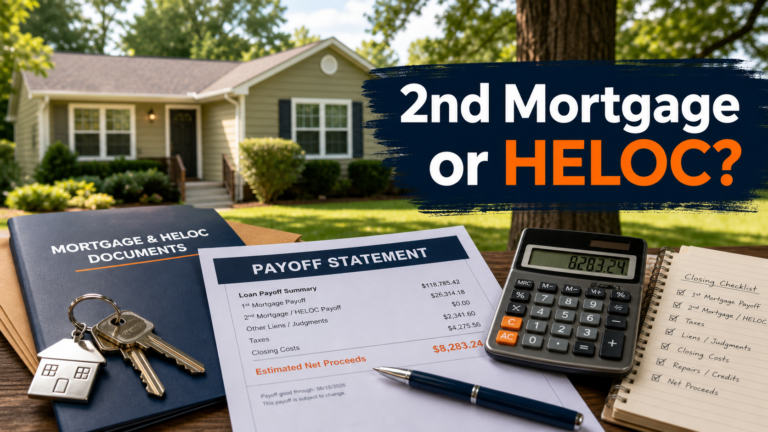
Start With The Payoff Stack, Not The Sale Price
If your house has a first mortgage plus a second mortgage, home equity loan, or HELOC, the first question is not only, "What is the house worth?"
The better first question is:
What has to be paid or resolved before this sale can close cleanly?
That list is the payoff stack.
For many Arkansas homeowners, the stack may include:
- first mortgage payoff
- second mortgage payoff
- HELOC payoff or line closure
- property taxes
- recorded liens or judgments
- closing costs
- title work
- repair credits
- cleanout or moving costs
- holding costs while waiting for closing
The sale may still be simple if there is enough equity. But when equity is tight, the second loan can change the whole decision. A house can have a strong market value on paper and still be hard to sell if the total payoff stack is too close to the likely sale price.
This article is general information for Arkansas homeowners. It is not legal, tax, foreclosure, bankruptcy, lending, or financial advice. If payoff, lien, title, tax, short sale, deficiency, foreclosure, or bankruptcy questions are involved, talk with your lender, title company, attorney, HUD-approved housing counselor, CPA, or another qualified professional before making a final decision.
What Counts As A Second Mortgage Or HELOC?
The Consumer Financial Protection Bureau explains that a second mortgage, sometimes called a junior lien, is another loan secured by the same house. Home equity loans and home equity lines of credit are common examples of second mortgages.
That matters because the loan is not just a monthly payment. It can also be a lien against the property.
Common examples include:
- a fixed home equity loan
- a HELOC with an open credit line
- a piggyback second mortgage from when the house was purchased
- an older second lien that may still show in title records
- a home equity product used for repairs, debt consolidation, emergencies, or other expenses
A HELOC can be especially confusing because it may feel like a credit card attached to the house. But if it is secured by the property, the title company and lender may need it addressed before ownership can transfer.
What Usually Happens At Closing
In a normal sale with enough equity, the payoff process is usually straightforward.
The closing company or title company requests payoff information, the buyer's funds come in at closing, secured loans are paid from the closing proceeds, and any remaining seller proceeds are distributed after approved costs and payoffs.
For a simple example:
| Item | Example Amount |
|---|---|
| Sale price | $180,000 |
| First mortgage payoff | -$115,000 |
| HELOC payoff | -$18,000 |
| Estimated closing costs and prorations | -$6,000 |
| Estimated seller proceeds before other costs | $41,000 |
In that kind of scenario, the second loan does not automatically stop the sale. It just has to be included in the numbers and handled correctly at closing.
The problem starts when the numbers are tighter.
When Equity Is Tight, The Decision Changes
The CFPB notes that if there is not enough equity to pay off both loans completely, the second mortgage lender may not get the full amount owed.
That is the point where sellers should slow down.
Consider this example:
| Item | Example Amount |
|---|---|
| Likely sale price | $155,000 |
| First mortgage payoff | -$118,000 |
| HELOC payoff | -$28,000 |
| Estimated closing costs and prorations | -$7,000 |
| Estimated seller proceeds before repairs | $2,000 |
On paper, that sale may still close. But what happens if the buyer asks for repairs? What if the title work finds another lien? What if taxes are owed? What if the house sits for two more months? What if the final payoff is higher than expected?
Now compare a tighter version:
| Item | Example Amount |
|---|---|
| Likely sale price | $145,000 |
| First mortgage payoff | -$118,000 |
| HELOC payoff | -$28,000 |
| Estimated closing costs and prorations | -$7,000 |
| Estimated shortfall before repairs | -$8,000 |
That is a different kind of decision. The homeowner may need to talk with the lender, title company, attorney, housing counselor, or other professional before signing a contract. A buyer cannot simply ignore a secured payoff because the seller wants to move.
If your concern is broader than a HELOC and includes very little equity overall, read Paranova's guide to selling a house with little to no equity in Arkansas.
Repairs Can Make The Payoff Stack Harder
A second mortgage or HELOC is not always the hardest part. Sometimes the real issue is the combination of debt plus property condition.
For example, the house may also have:
- roof problems
- foundation concerns
- old HVAC or plumbing issues
- water damage
- code violations
- belongings left inside
- vacancy or security problems
- deferred maintenance
- unpaid taxes or other liens
If the house is clean, updated, and financeable, listing may create enough buyer competition to make the payoff stack work.
If the house needs major repairs, the sale price a normal buyer can justify may be lower. A buyer with a mortgage may also run into appraisal, inspection, insurance, or lender concerns. A direct as-is buyer may be simpler, but the offer still has to be compared against the full payoff stack.
This is why "What is the house worth?" is only part of the answer.
The more useful question is:
After payoffs, closing costs, repairs, holding time, and risk, which sale path is actually workable?
Compare Three Sale Paths
Most sellers with a HELOC or second mortgage are comparing one of three paths.
| Path | When It May Fit | What To Watch |
|---|---|---|
| List on the open market | House is showable, financeable, and has enough equity | Repairs, buyer financing, inspection credits, commission, time |
| Sell directly as-is | House needs work, privacy, speed, or certainty matters | Offer must still cover the payoff stack or reveal a shortfall early |
| Pause for professional/lender guidance | Equity is tight, foreclosure pressure exists, or payoff status is unclear | Do not sign before understanding lender, title, legal, and financial consequences |
None of these paths is automatically right.
Listing may create the highest sale price. But it can also take longer and expose you to repairs, inspection requests, and buyer financing.
A direct as-is sale may trade some headline price for speed, certainty, and fewer seller obligations. But it is only useful if the numbers still make sense after the first mortgage, second mortgage or HELOC, taxes, liens, and closing costs are known.
Pausing may be the right move when the sale may not fully cover the debt. That is not a failure. It is a sign that you need the right information before the house is tied up under contract.
If you are already behind on payments, start with Paranova's page on selling a house behind on payments in Little Rock and Central Arkansas.
Questions To Ask Before You Sign
Before you sign a listing agreement, purchase contract, or direct-sale offer, try to answer these questions:
- What is the current first mortgage payoff?
- Is there a second mortgage, home equity loan, HELOC, judgment, tax lien, or other recorded lien?
- Is the HELOC still open, or does it need to be frozen or closed?
- What is the current payoff amount, and how long is that payoff quote valid?
- Are there unpaid taxes, insurance issues, HOA amounts, or other property charges?
- What are the estimated closing costs and prorations?
- Does the likely sale price leave room for repairs, concessions, or delays?
- If the numbers are short, who needs to approve the next step?
- Will the buyer use a title company?
- Does the contract allow enough time to confirm payoff and title details?
These questions are not meant to make the process feel complicated. They are meant to prevent a surprise late in the sale.
Watch For These Timing Problems
Even when the numbers work, timing can matter.
Potential problems include:
- payoff quotes expiring before closing
- the HELOC staying open after the seller thought it was closed
- a recent draw changing the payoff amount
- interest or fees changing the final payoff
- old liens appearing in title work
- a second lender needing more time to process a release
- the buyer asking for a repair credit after inspection
- closing delays increasing holding costs
The Arkansas Real Estate Commission has warned sellers to use qualified Arkansas real estate attorneys when complex real estate instruments are involved. That is good practical advice when the sale involves layered debt, unusual contracts, foreclosure pressure, or uncertainty about what has to be paid off.
When A Direct As-Is Offer Can Help
A direct as-is offer can be useful when you need a clear number before deciding what to do next.
For example, Paranova can usually look at:
- estimated property value in current condition
- repair burden
- cleanout or vacancy issues
- closing timeline
- likely as-is offer range
- seller obligations
- whether the offer appears to work against known payoff amounts
That does not replace lender, title, legal, tax, or financial advice. It simply gives you one practical sale-path number to compare.
If the offer does not work after the first mortgage, HELOC or second mortgage, taxes, liens, and closing costs, it is better to know that early. If it does work, you can compare it against listing, repairing first, or waiting.
If you are comparing more than one buyer, use Paranova's guide on how to compare cash home buyers in Arkansas before you sign.
When You Should Slow Down
Slow down before signing if:
- you do not know the payoff amounts
- the sale price may not cover all secured debts and costs
- foreclosure or collection pressure is involved
- an old second mortgage or HELOC appears unexpectedly
- there are title, judgment, tax, bankruptcy, divorce, probate, or estate issues
- the buyer does not want to use a title company
- the contract terms are hard to understand
- someone is pressuring you to sign before you can confirm the numbers
If there are recorded liens or judgments beyond the mortgage loans, read Paranova's article on selling a house with a lien or judgment in Arkansas.
How Paranova Can Help
Paranova Property Buyers helps homeowners in Little Rock and Central Arkansas compare practical options for problem or unwanted houses.
If your house has a HELOC, home equity loan, or second mortgage, Andrew can help you think through the sale path in plain language:
- what the property may sell for as-is
- what repairs or cleanout may affect
- what timeline is realistic
- what information a title company or lender may need
- whether a direct as-is sale is worth comparing
You do not need to have every payoff number before asking questions. But before closing, the payoff stack has to be clear.
The goal is not to pressure you into one path. The goal is to help you compare the real numbers before the house is tied up in the wrong kind of sale.